Overthinking at Night: Why Your Mind Won't Let You Sleep and What to Do About It
Overthinking at Night: Why Your Mind Won't Let You Sleep and What to Do About It
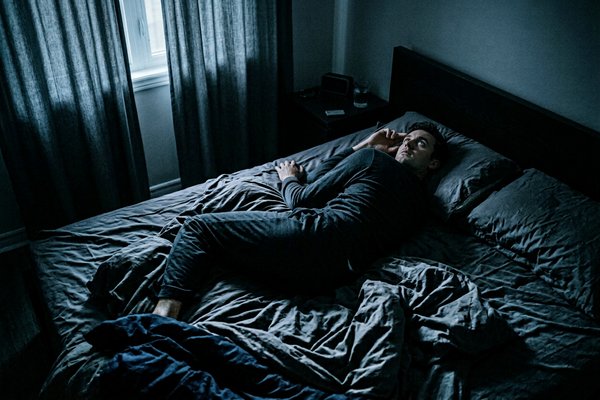
For many people who overthink persistently, night is when the loop is loudest. During the day there is enough going on, enough tasks, enough external stimulus, to partially interrupt the circling. At night, lying horizontal in the dark, that stimulus disappears. The loop fills the space that was previously occupied by everything else.
If this is familiar, you will know that it is not dramatic. It does not always feel like panic or crisis. It has a quieter quality: thoughts returning, assessments being run, conversations being replayed, the same questions arriving that arrived the night before. The mind is simply not ready to stop.
Why Night Makes the Loop Worse
The intensification of overthinking at night is not random. It follows directly from what the loop is doing and what the conditions of night remove.
During waking hours, activity provides natural breaks in focus on the loop's rotation. Tasks demand attention. Conversations require presence. Even passive activities like watching something or listening to music create enough cognitive engagement to partially suppress the loop's momentum. This suppression is not resolution, but it is distraction, and for most of the day it is enough to keep the loop below the threshold of acute discomfort.
What the Loop Is Doing at Night
At night, the suppression disappears. The loop runs at full rotation because nothing is distracting from it. The thoughts that were circling quietly underneath the day's activity surface fully. For people who overthink in relationships, this is often when the replaying and anticipating become most intense. This is not because night creates new problems. It is because night removes the conditions that were partially managing the loop without resolving it.
This matters because it means the solution is not better nighttime management. Addressing the problem at night is addressing it at the point where it is most acute, which is not the same as addressing it at the root. Left unaddressed, the nightly accumulation is one of the clearest signs that overthinking has started affecting your life beyond just the thinking itself. What the mind is circling at night is what it has been circling all day, below the surface. The night is where it becomes impossible to ignore.
Why Sleep Hygiene Does Not Fix It
Standard sleep hygiene advice addresses the conditions of sleep: screen time, room temperature, consistent schedules, relaxation techniques before bed. This is reasonable for people whose sleep difficulties are primarily environmental. For people whose sleep is disrupted by an active overthinking loop, it tends to produce limited results.
Attempting to force mental quiet at night tends to produce the same rebound effect it produces during the day. The loop does not respond to a cooler room or an earlier phone cut-off. It responds to having its underlying material addressed. A person who has surfaced and witnessed what they have been circling will often find that sleep becomes accessible in a way it was not before, not because their sleep hygiene improved, but because the thing the mind was working on has been resolved in a way that restless circling could not achieve.
Approaches to Night Overthinking Compared
What Actually Creates Relief
The relief that holds comes from addressing what the mind is actually circling, not from managing the conditions under which the circling happens. This requires identifying with precision what the loop has been returning to. Not the surface content, the specific conversation, the specific worry, the specific decision, but what that content is touching underneath.
When that underlying material is surfaced and articulated clearly, and when it is witnessed from outside rather than experienced from within the loop, something settles. The urgency the mind brought to the night's rotation dissipates. The same thoughts may return, but without the compulsive quality they previously carried. The mind no longer needs to keep circling because what it was circling has been seen.
A question built specifically for that pattern, one that the loop has not encountered before, deepens this settling. It does not provide an answer. It changes the relationship between the person and what they have been circling. And that change, rather than any adjustment to the bedroom environment, is what allows rest to become genuinely available.
Frequently Asked Questions
Why does my mind go quiet during the day and then become loud at night?
Because daytime activity suppresses the loop by occupying attention. The loop does not stop during the day. It continues below the threshold of awareness, partially managed by external demands. At night, those demands disappear, and the loop surfaces at full intensity. The quiet of the day is suppression, not resolution.
I wake at 3am with the same thoughts. Is that the same pattern?
Yes, typically. The 3am waking is the loop breaking through the shallow end of sleep. The mind was managing to sleep, but not deeply enough to prevent the pattern from surfacing when sleep lightened. The content circling at 3am is usually the same material as the pre-sleep loop, sometimes more compressed and more acute.
Could my night overthinking be clinical insomnia or anxiety?
It is possible, and if sleep disruption is severe and persistent, speaking with a medical professional is advisable. That said, many people who experience significant night-time overthinking do not have a clinical condition. They have a persistent loop that intensifies at night. These are different experiences and they respond to different approaches.
Is it worth doing the pattern work during the day, or does it need to happen at night?
It is worth doing at whatever time is practical and available. The loop does not need to be in full rotation for the pattern work to be effective. In fact, doing it during the day, when the loop is slightly below its most acute expression, often makes it easier to approach the underlying material with enough clarity to surface it properly.
If the loop is still running after everything you have tried, the issue probably is not the attempts. It is the approach.
Still Circling is a guided process designed for exactly this. For £19, it takes you through surfacing what is actually circling, articulating it fully, and receiving a single question built specifically for your pattern, one the loop has not encountered before. See how it works →